Showing posts with label VIDEO NEWS. Show all posts

Friday, 25 February 2011

Cutting the Cord

Date: 21-26 February 2011 (Mon - Wed: 8pm, Thurs - Sat: 6.30pm and 8.30pm)
Vanue: Tristan Bates Theatre, 1A Tower Street, Covent Garden, WC2H 9NP
Box office: 020 7240 6283
Email:
info@flyingeye.org.uk
Web:
http://www.tristanbatestheatre.co.uk/ http://www.flyingeye.org.uk/
Admission: £10/£8(Concession)
Organiser: Flying Eye


Inspired by true stories, Cutting the Cord is an intimate and heart-warming physical theatre piece.

This is the kind of theatre that engages and touches its audience long after they leave the venue. - The Brighton Magazine

Where do you come from?
Where are you going?
When you are miles away from the place of your birth, can you ever feel truly at home?

This one- woman show tells the story of Sachi, a young Japanese woman, and her comedic, yet sincere struggle to find a ‘home’. Set in London and Tokyo, Sachi playfully relates the story of what it means to leave one place and put down roots elsewhere. Accompanied by live music and presented with magical theatricality, Cutting the Cord is a touching and poignant tale that invites people of all backgrounds to celebrate their own journey in finding home.

Cutting the Cord is supported by Arts Council England, Great Britain Sasakawa Foundation and the Japan Foundation. Co-produced by The Basement and Brighton Festival.


Friday, 4 February 2011

Come and Play Korean Samulnori (Drums & Percussion) #3

Date: Saturday, February 12th, 3.00pm-4.30pm (for everyone interested) / 4.30pm-6.00pm (for those have some experience)
Venue: Goldmine Studios, 269 Poyser Street, London E2 9RF
Fee: £9 (all instrumens provided)
Contact: Jeung Hyun Choi (07981 298 638 / jeunghyunk40@gmail.com)

Samul nori is a genre of traditional percussion music originating in Korea. The word samul means "four objects" and nori means "play"; samul nori is performed with four traditional Korean musical instruments:

* Kkwaenggwari (a small gong)
* Jing (a larger gong)
* Janggu (an hourglass-shaped drum)
* Buk (a barrel drum similar to the bass drum)

The traditional Korean instruments are called pungmul.

Samul nori has its roots in nong-ak (literally "farmers' music"), a Korean folk genre comprising music, acrobatics, folk dance, and rituals, which was traditionally performed in rice farming villages in order to ensure and to celebrate good harvests. Specifically, samul nori music derives from utdari pungmul (the gut, or shaman ceremony rhythm of the Gyeonggi-do and Chungcheong provinces of South Korea), as well as the genres of Yeongnam folk music and Honam udo gut, combined with more contemporary improvisations, elaborations, and compositions. Such nong-ak is steeped in traditional animism and shamanism, but also shows influences from Korean Buddhism. While nong-ak often features the use of wind instruments, samul nori only features the aforementioned four percussion instruments.

Each of the four instruments represents a different weather condition: the janggu represents rain, the kkwaenggwari thunder, the jing the sounds of the wind, and the buk clouds. The idea of yin and yang is also reflected in these instruments: the buk and janggu (leather) represent the sounds of the earth, while the jing and kkwaenggwari (metal) represent sounds of the heavens. Although generally performed indoors, as a staged genre, samul nori depicts the traditional Korean culture, an agricultural society rooted in the natural environment.
Samul nori is characterized by strong, accented rhythms, vibrant body movements, and an energetic spirit.

Samul nori has gained international popularity, with many samul nori bands and camps worldwide. Since the 1980s in South Korea, there has been a marked increase in the amount of fusion music, combining samul nori and Western instruments.

Jeung-Hyun Choi is a Korean traditional percussion player and currently working as managing director of DULSORI, the Korean traditional music group. She has taught Korean traditional percussions and songs for over 20 years. Shae has led many international workshops in Korea and abroad, including SOAS World Music Summer School 2008.

Saturday, 15 January 2011

An extremely talented violinist, EungSoo Kim & Pianist, Moon Young CHAE

'This is the most beautiful violin sound I have ever heard!!'
(Hungarian Maestro Violinist and Conductor Tibor Varga)

'Perfect!'
(Strad, Korea)

'An extremely talented violinist with full of temperament, awareness of musical perception'…(Julian Rachlin, Concert Violinist)

EungSoo remarks himself as a musical virtuoso and his wide concert engagements demonstrate this: concerts with Sinfonie Orchester Berlin, Biel Symphony Orchestra, Göttingen Symphonie Orchester, Daegu Symphony Orchestra, Kyungbuk State Symphony Orchestra, Chungnam State Symphony Orchestra, Prime Philharmonic Orchestra and others. Especially, his recital in Poland was broadcasted by Radio Gdansk with very positive critics. Also, his debut in the Berliner Philharmonie hall in 2007 was highly successful and he was reinvited to perform Mendelssohn Concerto, Dvorak and Tchaikovsky Concertos. Moreover, his debut with Khachaturian Concerto in Seoul received overwhelming attention and a fantastic review. The concert was broadcasted on TBS Seoul.

The following concerts are solo performances with Orquestra de Cordoba, Prague Philharmonic Orchestra, Mantova Chamber Orchestra, Oviedo Filharmonica, Wonju Philharmonic Orchestra and Changwon Philharmonic Orchestra etc.

EungSoo is a top prize winner of the Zinetti International Chamber Music Competition, Maria Canals International Music Competition, Tibor Varga International Violin Competition, ‘Rodolfo Lipizer’ International Violin Competition and Spohr International Violin competition. EungSoo also played for Leonidas Kavakos, and he praised Eung Soo for his wide and diverse technical and musical capacity.

EungSoo was born in Korea and started the violin at seven. Only after a year, he won the first prize in the Ulsan local competition. After graduating Seoul Arts High School (Prof. Tae-Sik Pyung), he moved to Vienna and studied with the renowned teachers as professors Igor Ozim, Kriszstof Wegrzyn and Boris Kuschnir.

EungSoo has a CD from Azzurramusic supported by the City of Verona and the the next CD from Telos Music Records is already receiving high attention for its extraordinary quality and unique personality.

Moon Young CHAE, a Vienna-based pianist, performed the Grieg Piano Concerto when she was thirteen with Korean Symphony Orchestra where she was commented as a ‘sentational young pianist’. She extended her studies at the Purcell School in London and she studied with the world-leading teachers like Patsy Toh, Yonty Solomon and Irina Zaritskaya. She received the Master of Music Degree from the Royal College of Music where she also performed Scriabin Concerto with the RCM Sinfonietta.

Whilst having studied in London, Moon Young has received numerous scholarships such as Myra Hess Scholarship, Martin Scholarship and she won the Yamaha Scholarship Europe in 2002. Her achievements from competitions include the First prize from the Zinetti International Chamber Music Compeition and Maria Canals International Music Competition (2004), the Second prize in the Concorso Internazionale Ciltta di Pinerolo (2001), the Second prize in the Intercollegiate Beethoven Competition (2001) and the special prize in the Concorso Internazionale di esecuzione musicale Provincia di Caltanissetta.

Moon Young is also a devoted chamber musician. She has performed enourmous chamber music concerts and she has worked with professors like Boris Kuschnir, Pavel Vernikov and Igor Ozim and her partners include Julian Rachlin, Lidia Baich and Alisa Weilerstein and her husband Eung Soo KIM. She also has an album from the Decca with a Scriabin Prelude and the first album with Eung Soo Kim is released by Azzurramusic.

Moon Young has performed in prestigious venues such as Konzerthaus and Musikverein in Vienna, The Purcell Room, South Bank in London. Moon Young performs actively with Eung Soo KIM and as a soloist in Vienna, London, Lindau, Koblenz, Seoul, Daegu and venues including St. Matin-in-the-Field, London, Regent’s Hall (UK) Little Angels’ Concert Hall, Seoul (Korea), Stadttheater, Lindau (Germany), Gesellschaft für Musiktheater Wien, Beethoven Gedenkstätte, Schubertgeburtshaus (Vienna).


Thursday, 16 December 2010

Future Beauty: 30 Years of Japanese Fashion

Date: current - 6 February 2011
Time: Open daily 11am-8pm (Tue and Wed until 6pm), Thu until 10pm
Venue: Barbican Centre, Silk Street, London EC2Y 8DS


Future Beauty: 30 Years of Japanese Fashion is the first exhibition in Europe to comprehensively survey avant-garde Japanese fashion, from the early 1980s to the present. Curated by the eminent Japanese fashion historian Akiko Fukai, Director of the Kyoto Costume Institute, the exhibition explores the unique sensibility of Japanese design, and its sense of beauty embodied in clothing.
Japanese fashion made an enormous impact on the world fashion scene in the late 20th century and designers such as Issey Miyake, Rei Kawakubo and Yohji Yamamoto redefined the very basis of fashion. Their works will be shown alongside Kawakubo’s protégé, the techno-couturier Junya Watanabe, together with the acclaimed Jun Takahashi, and the new generation of radical designers including Tao Kurihara, Fumito Ganryu, Matohu, Akira Naka, Mina Perhonen and Mintdesigns.


Wednesday, 24 November 2010

Lotte Anker / Ikue Mori / Steve Noble at Cafe Oto

Date: SUNDAY 28 November 2010, 8.00pm
Venue: Cafe OTO, 18-22 Ashwin street, Dalston, London E8 3DL
Contact: info@cafeoto.co.uk
Tickets: £8 adv./£10 on the door


Saxophone, electronics and percussion duos and trios featuring three radical musicians from Copenhagen, New York and London. Channeling their experiences of no wave noise, free improvisation, ecstatic jazz, avant-garde composition and experimental electronics, Lotte Anker, Ikue Mori and Steve Noble come together for a unique evening of improvised explorations into unknown musical territory.

LOTTE ANKERLotte Anker is one of the most individual voices on the saxophone today, combining the power of Coltrane and Brötzmann with her own unique sense of space and balance. Drawing on the texts of Paul Auster, Jorge Luis Borges and others, she has also emerged as a crucial contemporary composer.

IKUE MORIIkue Mori has been a pioneering musical presence since she started playing drums with DNA in 1977. Switching from drums to drum machines to laptop, she is an essential figure in New York's experimental scene, collaborating with John Zorn, Sonic Youth, Evan Parker, and Christian Marclay.

STEVE NOBLESteve Noble is London's leading drummer, a fearless and constantly inventive improviser whose super-precise, ultra-propulsive and hyper-detailed playing has galvanized encounters with Derek Bailey, Matthew Shipp, Ishmael Wadada Leo Smith, Stephen O'Malley, Joe McPhee, Alex Ward, Rhodri Davies and many, many more.

Saturday, 13 November 2010

Four legends of the Japanese Avant-Garde: Otomo Yoshihide, Sachiko M, Reiko & Tori Kudo

Date: 6, 7 & 8 December, 2010
Venue: Cafe OTO, 18-22 Ashwin Street, Dalston London E8 3DL
Tel: 020 7923 1231
Email:
info@cafeoto.co.uk

Web: http://www.cafeoto.co.uk
Organiser: Cafe OTO

Maher Shalal Hash Baz kick off a three day stint at OTO featuring its enigmatic leader and cult figure in the Japanese underground Tori Kudo, his partner Reiko Kudo and musical mavericks Otomo Yoshihide and Sachiko M. The second evening will see all four play either solo or collaborate in different configurations. The final day will be led by Otomo Yoshihide & Sachiko M with special guests from the UK and beyond. A towering figure in the

Japanese underground music scene, Otomo's projects - frequently incorporating Sachiko M's banks of sine waves - embrace noise, minimal improvisation, free jazz and experimental rock.

MAHER SHALAL HASH BAZ
Maher Shalal Hash Baz is the artistic alter ego of Tori Kudo, a Japanese naivist composer and musician. The name is taken from Maher-shalal-hash-baz in the Book of Isaiah verses 8:1 and 8:3, and translates roughly as "Hurrying to the spoil, he has made haste to the plunder" or "Be quick if you steal something".

Tori Kudo has been cagey about details of his life before MSHB. He was once a member of a shadowy, revolutionary political party in Japan. However he gave up on politics since becoming a Jehovah's Witness. He also works as a ceramicist in his hometown in the remote Japanese island of Shikoku.

In his childhood he played classical and jazz piano - learning from the local jazz-kissa owner - as well as playing organ in a Protestant church. His other musical influences included T.Rex and saxophonist Steve Lacy. He and his wife Reiko Kudo joined a band called Worst Noise when they moved to Tokyo; other members dropped out, leaving Tori and Reiko as a duo, known simply as Noise. Under this name they released an album called 'Tenno' (trans. 'Emperor').

The impetus for Maher Shalal Hash Baz came when Tori met euphonium player Hiroo Nakazaki on a building site, and found that they shared an interest in the music of Mayo Thompson and Syd Barrett. Apart from the core trio (Tori on guitar and vocals, Reiko as vocalist, Hiroo with his euphonium), the lineup has always been fluid frequently featuring untrained musicians who sometimes seem only to have the barest grasp of their instrument.

After a couple of self-released cassette albums, the Japanese Org label released Maher Goes To Gothic Country (1991) and the 83-track box set Return Visit to Rock Mass (1996).

The group's profile outside Japan became much higher when Stephen McRobbie of The Pastels signed them to his Geographic label. They have released two albums on Geographic: the compilation From a Summer to Another Summer (An Egypt to Another Egypt) (2000) and the 41-track Blues Du Jour (2003); plus a number of EPs on various labels, including 'Souvenir De Mauve' (Majikick, 1999), 'Maher On Water' (Geographic, 2002), 'Faux Depart' (Yik Yak, 2003) and Live Aoiheya January 2003 (Chapter Music, 2005). Their most recent releases are 'L'autre Cap' (K Records, 2008) and the 171 track collection of musical miniatures 'C'est La Derniere Chanson' (K Records, 2009).

Tori Kudo has resisted defining the sound of his band, although in an interview with Tim Footman in Careless Talk Costs Lives magazine (August 2002) he declared "I am punk." There are also elements of folk, psychedelia and free jazz; the band's tendency to ask members of the audience to join in adds a sense of danger in live performance. Perhaps the best description comes from his own sleevenotes to From a Summer to Another Summer: "Error in performance dominates MSHB cassette which is like our imperfect life."


Wednesday, 10 November 2010

Laboratory Dance Project + Post-show Q&A

Date: 23 November 2010 (8.00 pm)
Venue: The Place, 17 Duke's Road, London WC1H 9PY
Tickets: £6-£17
Box Office: 020 7121 1100
Web: http://www.theplace.org.uk/
Nearest tube: Euston


The award-winning Seoul company Laboratory Dance Project, founded by artistic director Shin Chang-Ho, makes its London debut at The Place with a triple bill of incredible, physically charged, acrobatic dance work, which combines contemporary choreography, hip hop and martial arts.

Three distinct works define the extraordinary talent of these artists and performers.
Lee In Soo's Modern Feeling is an accomplished piece detailing the meetings, conflicts and compromises of two men. The work won the Grand Prix award at the Seoul International Choreographer Festival in 2008.

Jeon Mi Sook's Promise is a thoughtful examination of suspicion, prejudice, forgiveness and the freedom to be different, set to Steve Reich's classic Music for 18 Musicians.
In No Comment, the company's signature piece, a testosterone fuelled group of seven suited male dancers stalk and prowl the stage in an astonishing piece of high energy work. If you like Hofesh Shecher we think you will love this.


Wednesday, 20 October 2010

Come and Play Korean Samulnori (Drums & Percussion)

Date: Saturday, November 6th, 5.00pm-6.00pm
Venue: St Marks Church, Myddelton Square, London EC1R 1XX
Fee: £5 (all instrumens provided)
Contact: Jeung Hyun Choi (07981 298 638 /
jeunghyunk40@gmail.com or Lennie Charles (07534 736 806 / lennie.charles@googlemail.com)

Samul nori is a genre of traditional percussion music originating in Korea. The word samul means "four objects" and nori means "play"; samul nori is performed with four traditional Korean musical instruments:

* Kkwaenggwari (a small gong)
* Jing (a larger gong)
* Janggu (an hourglass-shaped drum)
* Buk (a barrel drum similar to the bass drum)

The traditional Korean instruments are called pungmul.

Samul nori has its roots in nong-ak (literally "farmers' music"), a Korean folk genre comprising music, acrobatics, folk dance, and rituals, which was traditionally performed in rice farming villages in order to ensure and to celebrate good harvests. Specifically, samul nori music derives from utdari pungmul (the gut, or shaman ceremony rhythm of the Gyeonggi-do and Chungcheong provinces of South Korea), as well as the genres of Yeongnam folk music and Honam udo gut, combined with more contemporary improvisations, elaborations, and compositions. Such nong-ak is steeped in traditional animism and shamanism, but also shows influences from Korean Buddhism. While nong-ak often features the use of wind instruments, samul nori only features the aforementioned four percussion instruments.

Each of the four instruments represents a different weather condition: the janggu represents rain, the kkwaenggwari thunder, the jing the sounds of the wind, and the buk clouds. The idea of yin and yang is also reflected in these instruments: the buk and janggu (leather) represent the sounds of the earth, while the jing and kkwaenggwari (metal) represent sounds of the heavens. Although generally performed indoors, as a staged genre, samul nori depicts the traditional Korean culture, an agricultural society rooted in the natural environment.
Samul nori is characterized by strong, accented rhythms, vibrant body movements, and an energetic spirit.

Samul nori has gained international popularity, with many samul nori bands and camps worldwide. Since the 1980s in South Korea, there has been a marked increase in the amount of fusion music, combining samul nori and Western instruments

Jeung-Hyun Choi is a Korean traditional percussion player and currently working as managing director of DULSORI, the Korean traditional music group. She has taught Korean traditional percussions and songs for over 20 years. Shae has led many international workshops in Korea and abroad, including SOAS World Music Summer School 2008.


Thursday, 29 July 2010

JAPANESE ART FESTIVAL

Date: Saturday 21st August-Sunday 22nd August 2010
Venue: Conway Hall, 25 Red Lion Square, Holborn, London WC1R 4RL
Web: http://www.japaneseartfestival.com/

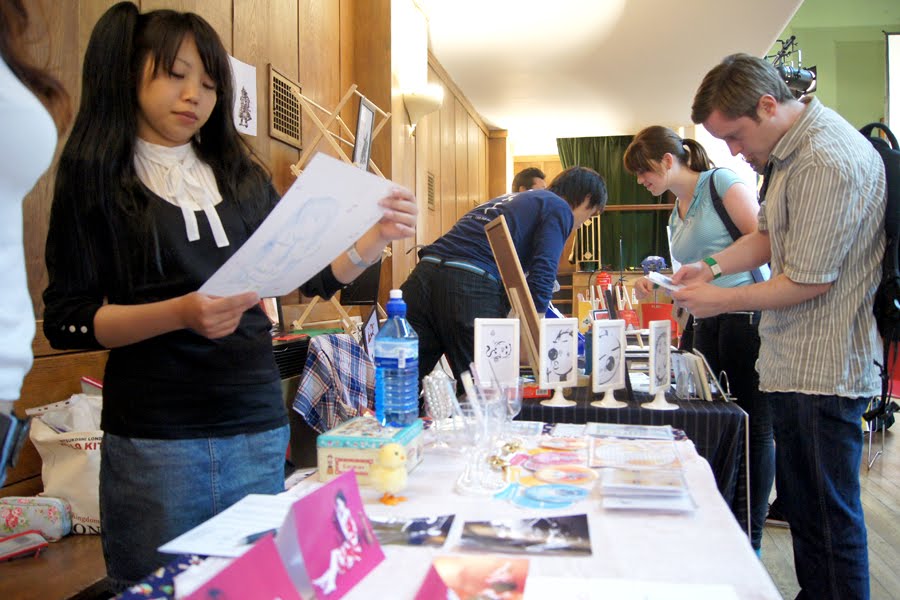
On 21st and 22nd August 2010, the fourth Japanese Art Festival will be presenting two days of art, cultural activities and fun at Conway Hall, Central London.

Akemi Solloway, the main organiser of the Japanese Art Festival, is a lecturer of Japanese culture and daughter of an old samurai family. It is her aim to present authentic Japanese culture in an accessible and enjoyable manner. In addition to Akemi, the core supporters of this festival are AJAMCA, the Anglo-Japanese Anime, Manga and Culture Association, and the School of Japanese Language and Culture.

In the friendly atmosphere of this event, if you come alone or with a group, you will find like-minded people, interesting things to see and do and the chance to take part in further activities in the UK and Japan.

Events
Kawaii Culture
Special guests 6%DOKIDOKI will be talking about the popularity of Kawaii Culture in Japan with the help of Akemi Solloway and guests.
Kimono Demonstration
The classic Japanese clothing gets a contemporary look as guest Yumi Yamamoto demonstrates the kimono with a modern twist. Meanwhile, Akemi Solloway will be explaining the style and wear of the traditional kimono.

Harajuku Fashion Show
A specially themed demonstration looking at the style from the legendary streets of Harajuku courtesy of 6%DOKIDOKI. Harajuku is a shopping area of Japan famed for its unique street fashion and this show gives you the opportunity to see why it's so well-reknowned.

Japanese Food
The Japanese Art Festival always provides a taste of Japan courtesy of our Yatai stands. Enjoy a range of food and drink including takoyaki, okonomiyaki, sake and soba.

Traditional Japanese Music
Enjoy some classic Japanese musical treats including performances on the Shamisen courtesy of guests Rodrigo & Eriko Hanawa, Shinobue (Japanese flute) and also the ever-popular Taiko drums.

Martial Arts
The Mid Sussex Martial Arts School (MSMAS) will be providing a variety of martial arts demonstrations live on stage. MSMAS teaches a variety of disciplines including Judo, Traditional Aikido, Iaido and Kendo.

Cosplay

The Japanese Art Festival will have a wide range of Cosplay-themed events over the course of the weekend, including the Cosplay Masquerade.

Dealers at the Japanese Art Festival
Attendees of the Festival will be able to purchase a wide range of items including DVDs, Manga, Japanese food, toys, T-Shirts, clothing and much more. Some of the companies attending the Japanese Art Festival include: Genki Gear, Kamika-Z, Gundam Nation, Voodoobaby, Japan Centre, United Publications, Third Window Films, Animetal
For more details please contact: Akemi Solloway info@japaneseartfestival.com


Thursday, 15 July 2010

TASTE THE EAST LONDON FESTIVAL 2010

On Friday the 9th of July 2010 and the following day-Saturday the 10th- TASTE THE EAST LONDON FESTIVAL 2010 took place at Potters Fields Park in London with the dramatic back drop of Tower Bridge'

Both days were gloriously sunny with temperatures reaching 30 degrees. Countless numbers of people, including tourists, promenaded and enjoyed the sunshine.

Numerous restaurants were represented at this Festival selling an assortment of delicious Korean and Japanese food and drinks-with of course, free tasting.

The various dishes included Korean pancakes (made with spring onions and seafood), Bulgogi (beef), noodles (with assorted sliced vegetables), chicken with onion and peppers on skewers, fried pork, fried chicken and curries with rice. Each restaurant contributing to the different tastes, smells and textures of the meals.

Japanese ice creams in different flavours (in tubs to be eaten with a spoon, a round shape(more solid to be picked up with one's fingers) and Green Tea lattes proved popular.

Other organisations (JNTO, JETRO, FINNAIR, Korea Tourism Organization, LE CORDON BLEU, Japan Foundation, Embassy of Japan in the UK, Eco Party Mearry, Institute of Traditional Korean Food, Atsuko’s Kitchen, Mizkan, Kikkoman, The Hanin Herald, Hollym Publication, A concept, Perfect Employment, The East Business Newspaper and Food Magazine) were present, including Maum Medication which offered fresh fruit salads and meditative advice.

Not only was there food to purchase but there were three separate cookery demonstrations on both days which attracted appreciative audiences.

(Click here to watch the YTN Report)

Different cooking methods for thick juicy steaks, fillets of pork, salmon, and chicken were transformed into mouthwatering dishes by two Japanese ladies (Atsuko, Utako Tanner) on both these days.

The third chef was Korean (Hokeon Kwak who had trained at LE CORDON BLEU in London) and displayed his skills , also on both the days, with dishes of beef and tofu.

Audiences on the Friday and Saturday were shown how to prepare remarkable meals and had the added pleasure of tasting them. To say their comments were favourable would be an understatement.

Unique hand crafted jewellery and accessories, together with an array of books and literature about Korea and Japan were available.

The entertainment provided highlighted vividly the range of artistic and Martial Arts talents on display.

A rather sombre display of Japanese Martial Arts were conducted in almost complete silence with members using their swords in menacing and stylised movements,

In contrast, was the "Wearing of the Kimono" demonstration assisted by a volunteer.

Four traditional Japanese dances were performed by dancers of varying ages, showing the skill required for the intricate movements, in perfect interpretation of the music.

The playing of different instruments showed the dexterity and musicality of the respective performers.

A "Daegum" or Korean flute was played hauntingly.

A "Kayagum"-a long stringed Korean instrument, placed horizontely on a stand was plucked skillfully (both modern and traditional tunes) by a musician in her Korean dress (Hanbok). She was joined by a guitarist for two pieces-including one of his own compositions.

A Japanese guitarist then played pieces at various tempos-his fingers seeming to fly over the strings during the fastest choice.

The highlight of the musical demonstrations over the two days of the Festival was on Saturday the 10th when remarkable explosive Japanese drumming skills and accompanying dancing combined.

A third impromptu performance by the drummers was added to the two scheduled ones due to the audience's encore request.

Good Summer weather, appreciative audiences, skillful performers and good food all contributed to the success of the TASTE THE EAST LONDON FESTIVAL 2010.


The East News